

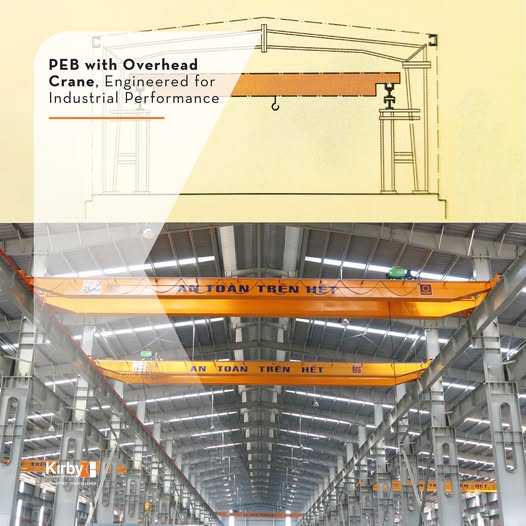
PEB with Overhead Cranes: 5 Key Design Considerations
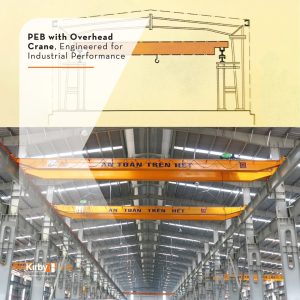
Rigid frame Pre-Engineered Buildings (PEB) can be engineered to support overhead crane systems for demanding industrial operations. Depending on project requirements, these structures can accommodate EOT crane systems with capacities of up to 15 MT and spans of up to 21 m.
However, designing PEB with overhead cranes requires careful consideration of additional forces generated during crane operations. Proper engineering helps maintain structural safety, durability and operational reliability.
At Kirby Southeast Asia, we understand the importance of coordinating building design and crane requirements from the earliest stages of an industrial project.
Table of Contents
- 1. Understanding PEB and Overhead Crane Systems
- 2. Understanding Crane Loads and Dynamic Effects
- 3. Choosing the Right Structural Support System
- 4. Five Important Design Considerations
- 5. Following Engineering Standards
- 6. Building for Long-Term Reliability
PEB with Overhead Cranes: Understanding the Structural Requirements
Pre-Engineered Buildings are widely used in industrial facilities, warehouses and manufacturing plants. Their structural systems can accommodate different building dimensions, operational requirements and equipment loads.
When an overhead crane is incorporated into a PEB, engineers must consider both building loads and additional forces generated by crane operations.
For example, rigid frame PEB systems can support EOT crane systems with capacities of up to 15 MT and spans of up to 21 m, subject to project-specific engineering requirements.
Successful PEB with overhead cranes projects require coordination between the building structure, crane specifications and operational needs.
2. Understanding Crane Loads and Dynamic Effects
Unlike buildings that primarily support static loads, crane-supported structures experience additional forces during operation.
Crane lifting, movement and braking can generate dynamic effects. Engineers must evaluate these forces during structural analysis.
Important crane-related loads include:
- Vertical wheel loads: Forces transferred from crane wheels to runway beams and supporting columns.
- Impact effects: Additional forces associated with lifting and crane movement.
- Lateral forces: Horizontal forces generated by trolley movement and crane operation.
- Longitudinal forces: Forces associated with crane acceleration and braking.
- Combined load effects: Different loading conditions evaluated together according to design requirements.
Accurate load calculations help engineers understand how crane operations affect the building and its supporting members.
3. Choosing the Right Structural Support System
The crane support arrangement directly influences the structural design of an industrial building.
One option is a bracket-mounted crane runway system. In this arrangement, runway beams are supported by brackets connected to the building columns.
For projects with higher crane capacities or specific structural requirements, independent support columns may also be considered.
The appropriate solution depends on crane capacity, runway geometry, building configuration and structural requirements.
Properly engineered PEB with overhead cranes systems require coordination between the main frame, runway beams and supporting columns.
4. Five Important Design Considerations
Five important engineering considerations help ensure reliable crane-supported building performance.
1. Crane Runway Configuration
Determine whether bracket-mounted runway beams or independent support columns are suitable for the project.
The decision should consider crane capacity, building layout and structural requirements.
2. Impact Allowance
Consider the applicable impact allowance during structural calculations.
A range of 10–25% of the maximum wheel load may serve as a preliminary reference where appropriate. The actual value must follow the governing design criteria and crane specifications.
3. Lateral Forces
Evaluate horizontal forces generated by trolley movement and crane operation.
A 20% lateral force is a reference value from the initial project brief, not a universal design requirement. Engineers must verify the applicable value against relevant standards.
4. Structural Stability
Check the strength and stability of columns, beams, connections and supporting members under relevant crane load conditions.
Proper structural detailing helps maintain building stability and reliable crane operations.
5. Load Combinations
Verify critical load combinations to ensure the structure can safely resist the required design conditions.
Both building loads and crane-related forces must be considered during structural analysis.
These considerations are essential for reliable PEB with overhead cranes designs. Actual design values must follow applicable standards, project data and crane manufacturer’s information.
5. Following Engineering Standards
Crane-supported buildings require appropriate engineering standards and careful technical evaluation.
The American Institute of Steel Construction (AISC) and the Metal Building Manufacturers Association (MBMA) provide important references for structural steel design and metal building systems.
Engineers should identify applicable requirements according to project specifications, local regulations and governing design codes.
Coordination with crane manufacturers is equally important. Accurate information about crane capacity, wheel loads, operating conditions and braking forces supports effective structural design.
For additional technical information, visit:
- American Institute of Steel Construction (AISC) – Standards
- Metal Building Manufacturers Association (MBMA)
6. Building for Long-Term Reliability
Crane-supported buildings are dynamic structural systems. Their performance depends on accurate load calculations, suitable structural arrangements and properly detailed connections.
Careful engineering coordination helps reduce structural risks and supports long-term industrial operations.
Choosing PEB with overhead cranes requires an integrated engineering approach. Every design decision contributes to building safety, operational efficiency and structural performance.
At Kirby Southeast Asia, we focus on engineered steel building solutions that meet project requirements.
Our approach emphasizes structural performance, fabrication quality and construction coordination.
Explore our structural steel solutions to learn more about our building capabilities.
For project enquiries, contact our team at sales@kirby.vn.