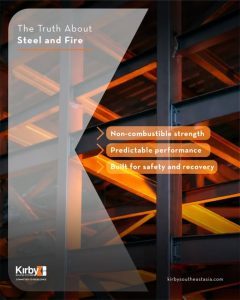


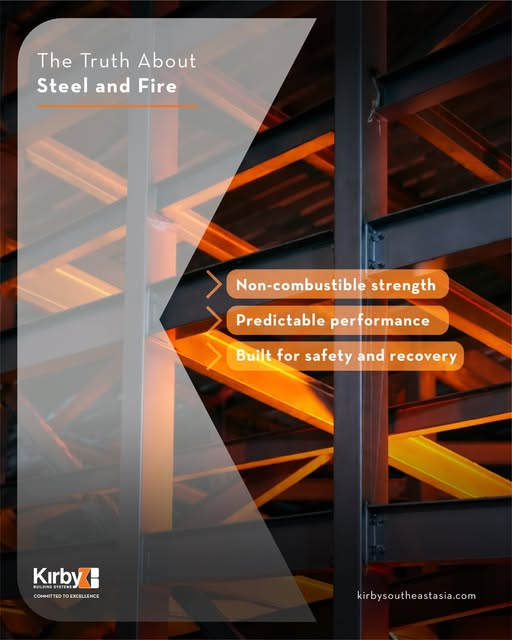
Steel Fire Protection: 5 Facts About Steel and Fire
Steel Fire Protection is an essential consideration in modern structural engineering. Although steel is non-combustible and does not act as fuel in a fire, its load-carrying capacity can change when exposed to elevated temperatures.
Understanding how steel behaves during a fire helps engineers develop effective protection strategies for industrial and commercial buildings.
Unlike combustible materials, structural steel does not contribute fuel to a fire. However, high temperatures can reduce its strength and stiffness, affecting the stability of structural members.
Through proper engineering, appropriate structural design, and passive fire protection systems, steel buildings can be designed to meet specified fire-resistance requirements.
At Kirby Southeast Asia, we believe effective steel fire protection starts with understanding the material, evaluating project risks, and selecting suitable protection solutions.
Table of Contents
- What Happens When Steel Is Exposed to Fire?
- Why Steel Is a Reliable Structural Material in Fire Engineering
- 5 Important Facts About Steel Fire Protection
- Common Passive Fire Protection Methods for Steel
- How Engineers Design Steel Structures for Fire Safety
- Kirby Southeast Asia: Building with Fire Safety in Mind
- Frequently Asked Questions
- Conclusion
1. What Happens When Steel Is Exposed to Fire?
Steel is non-combustible, meaning it does not burn or act as fuel in a fire. However, this does not mean structural steel is unaffected by extreme heat.
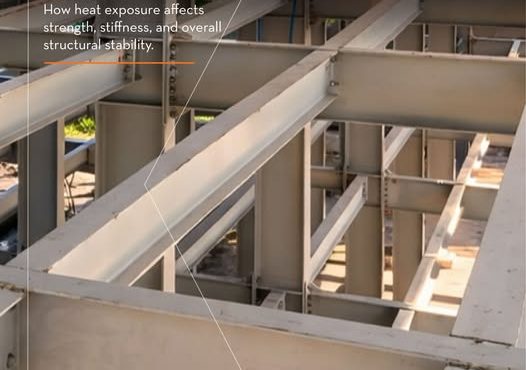
When exposed to elevated temperatures, steel gradually loses strength and stiffness. Its ability to carry structural loads can therefore decrease.
Thermal expansion and deformation may also affect the performance of connected structural members.
The actual response depends on several factors, including temperature, exposure duration, member dimensions, applied loads, and the structural system.
This is why steel fire protection is an important part of structural engineering.
Engineers evaluate these conditions when designing steel buildings. The objective is to ensure that structural members can maintain their required performance during a specified fire scenario.
2. Why Steel Is a Reliable Structural Material in Fire Engineering
One important advantage of steel in fire engineering is its predictable material behaviour.
Its mechanical properties and response to elevated temperatures can be studied through testing, engineering calculations, and established design methods.
This allows engineers to assess structural performance and determine suitable protection requirements.
According to the National Institute of Standards and Technology (NIST), structural fire-resistance design considers material behaviour, fire exposure, heat transfer, and structural response.
These principles help engineers develop appropriate fire safety strategies for steel buildings.
With suitable design and protection, steel structures can meet specified fire-resistance performance objectives and support building evacuation and firefighting operations.
3. 5 Important Facts About Steel Fire Protection
Understanding these five facts helps explain why fire protection must be considered throughout the design and construction of steel buildings.
1. Steel Is Non-Combustible
Steel does not burn or contribute fuel to a fire.
This is an important characteristic in structural fire engineering because the material itself does not support combustion.
However, non-combustibility does not mean unlimited resistance to heat. Steel members still require appropriate design and protection based on project requirements.
2. High Temperatures Reduce Steel Strength
Although steel maintains its structural properties under normal operating conditions, elevated temperatures can reduce its yield strength and stiffness.
As the temperature increases, structural members may experience greater deformation and reduced load-carrying capacity.
Engineers must account for these changes when determining the required fire resistance of a building.
3. Steel Has Predictable Behaviour Under Fire Exposure
Steel’s response to elevated temperatures can be modelled and evaluated using engineering methods and testing.
This allows designers to assess potential structural behaviour under defined fire scenarios.
Predictable material behaviour also helps engineers select appropriate protection systems and establish performance targets.
4. Passive Fire Protection Helps Maintain Structural Stability
Passive fire protection systems are designed to slow heat transfer to structural steel members.
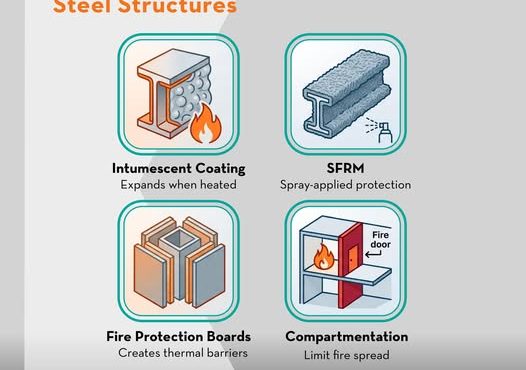
Common solutions include insulation materials, intumescent coatings, and fire-resistant barriers.
When correctly specified and installed, these systems help maintain structural performance for the required fire-resistance period.
5. Proper Fire Protection Can Support Post-Fire Recovery
A fire incident does not automatically mean every steel component must be replaced.
Depending on the severity and duration of exposure, structural assessment may identify components that remain suitable for repair or potential reuse.
However, reuse decisions must be based on professional inspection, material assessment, and verification of structural capacity.
This makes appropriate steel fire protection an important consideration for both building safety and long-term asset management.
4. Common Passive Fire Protection Methods for Steel
Passive fire protection is an important part of protecting structural steel against elevated temperatures.
Different systems provide different levels of protection depending on the building design, fire-resistance requirements, and environmental conditions.
Common methods include:
Intumescent Coatings
Intumescent coatings are specialist protective paints that expand when exposed to high temperatures.
They form an insulating char layer over the steel surface, helping slow the rate of temperature increase in structural members.
These coatings are often selected where maintaining the appearance of exposed steel is important.
Fire-Resistant Insulation
Fire-resistant insulation materials help reduce heat transfer to steel components.
They can be applied to structural members to delay temperature increases during fire exposure.
The required thickness and system specification depend on the design conditions and required fire-resistance rating.
Fire Barriers and Protective Enclosures
Fire barriers and protective enclosures help limit fire and heat exposure between different building areas.
They are important components of a wider fire safety strategy, supporting compartmentation and helping restrict fire spread.
The selection of each protection method should be based on engineering calculations, tested system performance, installation requirements, and applicable building regulations.
5. How Engineers Design Steel Structures for Fire Safety
Effective steel fire protection begins during the engineering and design stages.
Engineers consider several factors to establish suitable structural fire performance.
These include:
- Structural member selection: Choosing appropriate steel sections based on structural loads and design requirements.
- Load evaluation: Assessing applied loads and structural capacity under the relevant fire design conditions.
- Fire-resistance requirements: Determining the required performance period according to building use and local regulations.
- Protection system selection: Specifying suitable insulation, intumescent coatings, or fire barriers.
- Installation quality: Ensuring protective systems are installed according to approved specifications and manufacturer requirements.
Fire safety is not achieved through protective coatings alone.
It requires coordination between structural engineering, fire protection design, construction quality, and regulatory compliance.
For further technical information, explore the National Institute of Standards and Technology’s guidance on structural fire resistance design.
6. Kirby Southeast Asia: Building with Fire Safety in Mind
At Kirby Southeast Asia, we understand that structural safety is a fundamental part of responsible building design.
Our engineering approach considers project requirements, structural performance, and applicable fire safety criteria.
We integrate specified fire-protection solutions according to each project’s risk profile and local regulations.
Through appropriate structural design and coordination with fire protection specialists, we aim to support steel building solutions that meet the required performance objectives.
Fire safety is also connected to the broader lifecycle of a building.
Explore our Pre-Engineered Steel Building solutions to learn more about our approach to modern steel construction.
You can also read Reusable Steel Buildings: 5 Benefits of Designing for Reuse to discover how adaptable steel structures can support more sustainable building strategies.
At Kirby, we believe that strong engineering is not only about structural strength. It is also about protecting people, assets, and long-term building performance.
Build with confidence. Build with Kirby.
Contact our team at sales@kirby.vn to discuss your next steel building project.
7. Frequently Asked Questions
Does steel burn in a fire?
No. Steel is non-combustible and does not act as fuel in a fire.
However, elevated temperatures can reduce its strength and stiffness, so structural fire protection may be necessary.
Does steel lose strength when exposed to fire?
Yes. Steel’s mechanical properties change as its temperature increases.
Its yield strength and stiffness can decrease, potentially affecting structural stability and load-carrying capacity.
What is passive fire protection for steel structures?
Passive fire protection refers to systems that help protect structural steel from heat exposure.
Common solutions include intumescent coatings, fire-resistant insulation, and fire barriers.
Why are intumescent coatings used on steel?
Intumescent coatings expand when exposed to high temperatures and form an insulating layer.
This helps slow the heating of steel members and supports the required fire-resistance performance.
Can steel structures be reused after a fire?
Potentially, yes. Some steel components may remain suitable for reuse after a fire, depending on their exposure history, physical condition, and verified structural properties.
Professional inspection and engineering assessment are essential before reuse.
8. Conclusion
Steel is a non-combustible structural material with predictable behaviour under elevated temperatures.
However, maintaining structural stability during a fire requires appropriate engineering and protection measures.
Through proper structural design, passive fire protection, and quality installation, steel buildings can be designed to meet specified fire-resistance requirements.
At Kirby Southeast Asia, we believe fire safety begins with engineering knowledge and responsible design decisions.
Steel is Strong. Safety Comes First. Build with Kirby.