

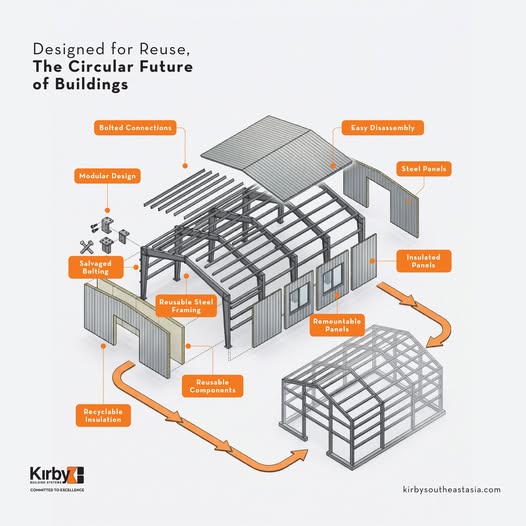
Design for Reuse: The Future of Sustainable Steel Buildings
What if a building’s lifecycle did not end when its original purpose changed—but instead became the starting point for its next use?
The construction industry is increasingly exploring a circular approach, moving beyond the traditional linear model of build, use, and demolish. Instead, buildings and materials can be designed with adaptability, reuse, and longer-term value in mind.
Steel plays an important role in this transition.
With the right engineering and planning, design for reuse can help create buildings that are more adaptable to changing operational requirements while supporting more efficient use of materials throughout their lifecycle.
What Is Design for Reuse?
Design for reuse means considering what could happen to a building and its components beyond their initial application.
Instead of designing only for today’s requirements, engineers and project teams can consider future scenarios such as:
- Changes in building use
- Expansion or modification
- Relocation of selected structures
- Reuse of structural components
- Disassembly at the end of a building’s service period
This approach can help to extend the useful life of materials and reduce the need for unnecessary demolition and replacement.
How Pre-Engineered Steel Buildings Support Reuse
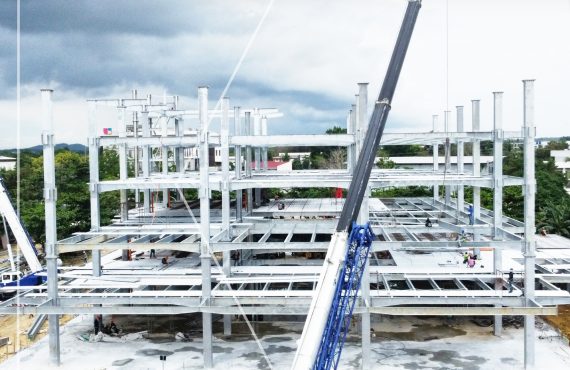
Pre-engineered steel buildings (PEB) can offer flexibility that supports circular construction strategies when reuse and adaptability are considered during the design stage.
1. Structures Can Be Designed for Disassembly
Steel structures are assembled from individual structural members and connections rather than being formed as one continuous mass.
With appropriate design and connection strategies, selected components may be capable of being dismantled and potentially reused when a building is modified, relocated, or repurposed.
The actual feasibility of reuse depends on factors such as the original design, connection details, component condition, loading requirements, and the requirements of the next application.
2. Components Can Support Multiple Applications
Structural steel components can potentially have value beyond their original project.
When components are carefully designed, documented, maintained, and assessed for their condition and structural capacity, they may be suitable for reuse in future applications.
This creates an opportunity to keep materials in productive use for longer rather than treating them as waste at the end of a building’s initial use.
3. Buildings Can Adapt to Changing Needs
Business and urban requirements rarely remain unchanged throughout a building’s entire lifecycle.
Facilities may need additional space, modified layouts, new equipment, or changes in operational use.
A PEB system can provide design flexibility for certain types of expansion and modification, allowing the building to evolve with changing requirements rather than automatically requiring demolition and reconstruction.
From Linear Construction to Circular Construction
Traditional construction has often followed a relatively linear model:
Build → Use → Demolish
A circular approach aims to keep materials, components, and buildings in use for as long as practical:
Design → Build → Use → Adapt → Reuse
Designing with this lifecycle in mind can help project teams consider material efficiency from the beginning of the project rather than only at the end.
For steel buildings, this means thinking beyond the initial construction phase and considering how structural components could contribute to future building applications.
The Environmental Value of Reuse
Reuse can contribute to more efficient resource use by extending the useful life of existing materials and potentially reducing demand for new materials.
It can also help reduce construction and demolition waste when existing structures or components can be adapted rather than completely replaced.
However, the environmental benefits of reuse depend on the specific project. Transportation, refurbishment, additional processing, structural assessment, and the condition of existing components all need to be considered when evaluating the overall lifecycle impact.
This is why design for reuse should be approached as an engineering and lifecycle strategy—not simply as a sustainability slogan.
Designing for a Future That Can Change
Future-ready buildings need to accommodate uncertainty.
A facility that can be expanded, modified, or adapted may provide greater long-term value than one designed only around its original requirements.
For PEB projects, this can mean considering future expansion zones, connection details, structural capacity, access for modification, and documentation during the initial engineering stage.
These decisions can make future changes more predictable and potentially reduce the need for major reconstruction.
Building the Circular Future with Steel
As cities grow and industrial requirements continue to change, the construction industry has an opportunity to rethink how buildings are designed and used.
Steel offers valuable characteristics for this transition because structural systems can be engineered around individual components, connections, adaptability, and potential future applications.
Design for reuse is therefore not simply about what happens when a building reaches the end of its first use. It is about making better decisions at the beginning so that buildings and materials can remain valuable for longer.
At Kirby Southeast Asia, we believe smarter engineering means thinking beyond the first project phase. By combining efficient PEB systems with practical design considerations, we help create steel building solutions that are adaptable, efficient, and prepared for changing requirements.
Let’s Build for What Comes Next
The future of sustainable construction is not only about building less.
It is also about building smarter, adapting better, and keeping materials in use for longer.
Design for reuse can help move the industry toward a more circular and future-ready built environment.
Engineered for Project Certainty.
For more information about our steel building solutions: