

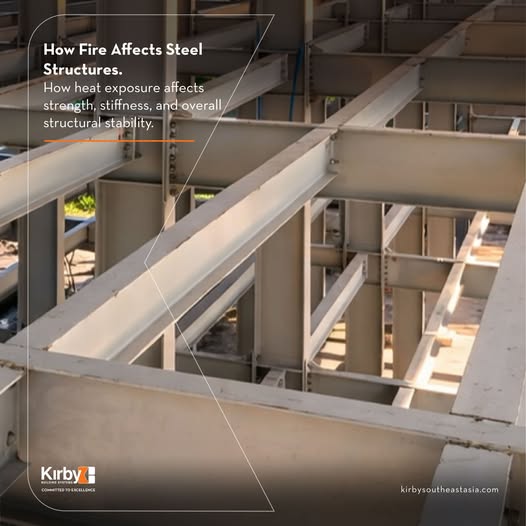
Steel and Fire: How Fire Affects Steel Structures
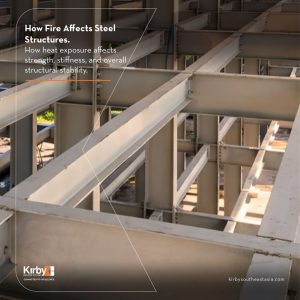
Steel does not burn, but high temperatures can significantly affect its structural performance. When exposed to fire, steel gradually loses strength and stiffness, which may compromise the stability and safety of a building.
Understanding the fire effects on steel structures is essential for engineers, architects and building owners. Appropriate fire protection measures help maintain structural integrity and support safer industrial and commercial buildings.
In this article, we explore five important aspects of how fire affects steel structures and the protection methods used to improve their fire resistance.
Table of Contents
- 1. Understanding Fire Effects on Steel Structures
- 2. How Temperature Changes Steel Properties
- 3. How Fire Reduces Structural Strength
- 4. Five Factors That Influence Fire Performance
- 5. Common Steel Fire Protection Methods
- 6. Why Fire Protection Matters in Building Design
- Building Safer Steel Structures
1. Understanding Fire Effects on Steel Structures
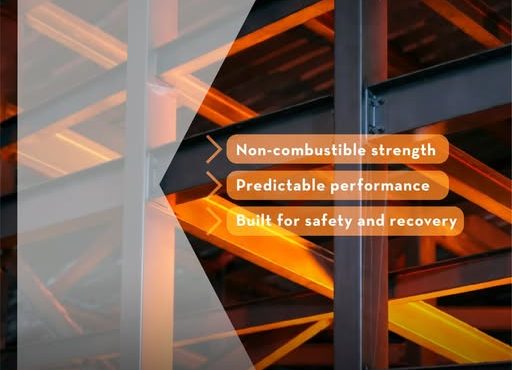
Steel is a non-combustible construction material. However, non-combustibility does not mean that steel is unaffected by fire.
When exposed to high temperatures, steel gradually changes its mechanical properties. Its strength and stiffness decrease, making structural members less capable of carrying their intended loads.
The extent of these changes depends on temperature, exposure time, loading conditions and the characteristics of the structural system.
Understanding these fire effects on steel structures helps engineers identify potential risks and determine suitable fire protection requirements during the design process.
2. How Temperature Changes Steel Properties
As temperature increases, structural steel gradually loses its yield strength and stiffness. This means that steel members may no longer perform as effectively as they do under normal conditions.
At approximately 600°C, some structural steel grades may retain only around 50% of their room-temperature yield strength. Actual performance depends on the steel grade and applicable design assumptions.
This reduction is important because structural members must continue to resist the loads acting on them during a fire.
Engineers therefore consider temperature-related material changes when evaluating fire resistance and designing appropriate protection systems.
3. How Fire Reduces Structural Strength
Steel does not need to reach its melting point for a structure to experience serious fire-related damage. At much lower temperatures, reduced strength and stiffness can affect structural performance.
As steel becomes hotter, beams and columns may experience increased deformation. This can lead to excessive deflection under certain loading conditions.
In more severe situations, structural members may experience local buckling or other forms of instability.
The consequences depend on the building’s structural configuration, connections and loads during the fire event.
For this reason, fire resistance must be considered as part of the overall structural design, rather than focusing only on normal-temperature performance.
4. Five Factors That Influence Fire Performance
The fire performance of a steel structure depends on several connected factors. Understanding these factors helps engineers assess risks and select appropriate protection measures.
- Fire intensity: Higher temperatures can accelerate the loss of steel strength and stiffness.
- Duration of exposure: Longer exposure allows more heat to transfer into structural members.
- Load level: The loads acting on a member during a fire influence its ability to withstand reduced strength.
- Structural configuration: Member dimensions, connections and the overall structural system affect how a building responds to fire.
- Fire protection systems: Suitable protective materials can delay the temperature rise of structural steel.
These factors should be evaluated together when assessing fire effects on steel structures. Considering them during design helps project teams determine suitable fire-resistance requirements.
5. Common Steel Fire Protection Methods
Modern buildings use different fire protection systems to help steel members maintain their load-bearing capacity for a specified period.
The appropriate solution depends on project requirements, building regulations and the required fire-resistance rating.
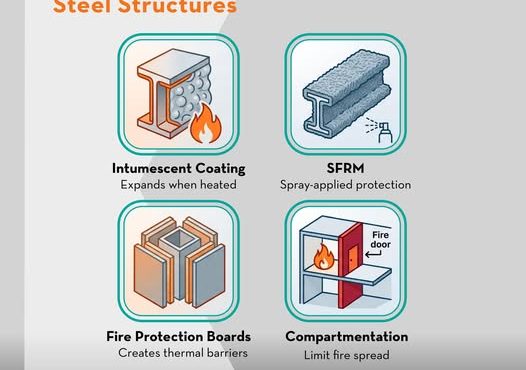
Intumescent Coatings
Intumescent coatings expand when exposed to high temperatures, forming an insulating char layer around the steel surface.
This layer slows heat transfer and helps delay the temperature rise of structural members during a fire.
Sprayed Fire-Resistive Materials
Sprayed fire-resistive materials (SFRM) create an insulating layer on steel surfaces. They are used in suitable building applications to reduce the rate at which structural steel heats up.
Fire-Rated Encasement Systems
Fire-rated encasement systems protect steel members by surrounding them with approved fire-resistant materials.
Depending on the design, these systems may use boards or other tested protective assemblies to achieve the required fire-resistance performance.
Each method must be selected and installed according to its tested performance and the project’s fire protection specifications.
Correct installation and inspection are also essential to achieving the intended level of protection.
6. Why Fire Protection Matters in Building Design
Fire protection should be considered from the early stages of a building project. Engineers need to evaluate structural requirements, building use and applicable regulations.
For industrial and commercial buildings, this process is particularly important. Large open spaces, equipment layouts and operational activities can influence fire safety requirements.
Effective fire engineering combines structural design, appropriate protective materials and coordinated installation.
Inspection and maintenance are also important to help ensure that protection systems continue to perform as intended.
A clear understanding of fire effects on steel structures allows project teams to make informed decisions and develop buildings with suitable levels of fire resistance.
Building Safer Steel Structures
Steel offers strength, flexibility and many advantages for modern construction. However, its mechanical properties change significantly when exposed to high temperatures.
Fire protection is therefore an important part of responsible steel building design. Engineers need to understand temperature-related strength loss and evaluate potential structural risks.
By selecting suitable protection systems and following appropriate design and installation requirements, project teams can help improve building safety and resilience.
At Kirby Southeast Asia, we believe that structural performance starts with sound engineering and careful project planning.
Explore our structural steel solutions to learn more about steel building systems for industrial and commercial applications.
For further technical information about fire safety and structural performance, visit the National Institute of Standards and Technology (NIST) Fire Research Division and the European Commission’s Eurocodes information portal.
For enquiries about steel building solutions, contact Kirby Southeast Asia at sales@kirby.vn.